

The Morning Ritual Nobody Questions
Most of us reach for our phones before our eyes are even fully open. Notifications, messages, headlines, and endless updates are already waiting before we brush our teeth or say good morning to anyone in the room. What starts as a quick check stretches into ten minutes, then fifteen, then longer. Other people’s vacations, promotions, relationship milestones, and gym results scroll past while the day has barely started. It feels normal because everyone does it, and things that everyone does rarely get questioned.
But behind this daily habit, psychologists and researchers are asking a serious question. Is social media quietly making us more anxious? The answer is not simple, and it is not a yes or no. Social media did not invent anxiety. Humans were worrying long before smartphones existed. What social media has done is create a digital environment where our brains are exposed to thousands of emotional signals, social comparisons, and attention-grabbing triggers every single day. Our minds were never built to process that volume. That mismatch is where the problem begins, and understanding it is worth the conversation.
The Brain Was Built for a Much Smaller World
For most of human history, people lived in small, tight communities. Anthropologists often reference something called Dunbar’s Number, the idea that human brains can comfortably maintain roughly 150 meaningful social relationships. That number matters because our brains evolved around it. Social media dissolved that boundary entirely. A single person today may follow hundreds or thousands of accounts across multiple platforms, each one feeding the brain a steady stream of updates, achievements, and social signals from people it was never designed to track.
When someone posts a promotion, your brain compares it to your own career. When vacation photos appear, your mind evaluates your own life against them. When fitness results fill the screen, your sense of your own body shifts in response. Even when you know those posts are curated highlights and not the full picture, the emotional brain still reacts as though they are real and current. Over time, that constant comparison creates a low-level current of self-doubt and dissatisfaction that many people feel without being able to name its source. The brain is doing exactly what it evolved to do. The environment it is doing it in is the problem.
The Comparison Trap Has No Exit Sign
Imagine walking into a room where hundreds of people are talking about the best moments of their lives simultaneously. Someone just bought a house. Another person is celebrating a new job. Someone else is announcing an engagement. A couple is sharing photos from a trip that looks like a dream. Now imagine that room never closes and you carry it in your pocket everywhere you go. That is the experience social media creates for its users, and it runs on an engine that never powers down.
Your brain is constantly measuring your unfiltered daily reality against other people’s carefully selected highlights. Bills, bad days, unfinished goals, and ordinary Tuesday afternoons do not make it onto feeds. The polished version does. When your comparison point is always someone else’s best moment, your own life starts to feel smaller than it is. This is not a sign of weakness or insecurity. It is a predictable neurological response to a distorted environment. Knowing that does not make the feeling disappear, but it does give you somewhere to put it other than directed inward at yourself.
Information Overload Is Draining You Without Your Permission
Beyond comparison, there is the sheer volume of information hitting the brain during a typical scroll session. A generation ago, the daily flow of information came from a newspaper, a few conversations, and the evening news. The pace was slow enough that the brain could process one thing before the next arrived. Today, a few minutes of scrolling can deliver a viral video, breaking political news, a celebrity controversy, economic anxiety, fitness advice, and a friend’s personal update, all before the coffee is ready.
The brain processes each of these inputs emotionally, even when scrolling feels passive and relaxing. Every piece of content activates a small judgment, reaction, or comparison. Multiply that across an hour of browsing and the cumulative mental load is significant. Many people describe feeling inexplicably drained after time online, even when they were not doing anything that felt demanding. That exhaustion is real. The mind was working the entire time, processing a volume of social and emotional information it was never designed to handle at that speed or scale.
Doomscrolling Is Not a Bad Habit. It Is a Design Feature.
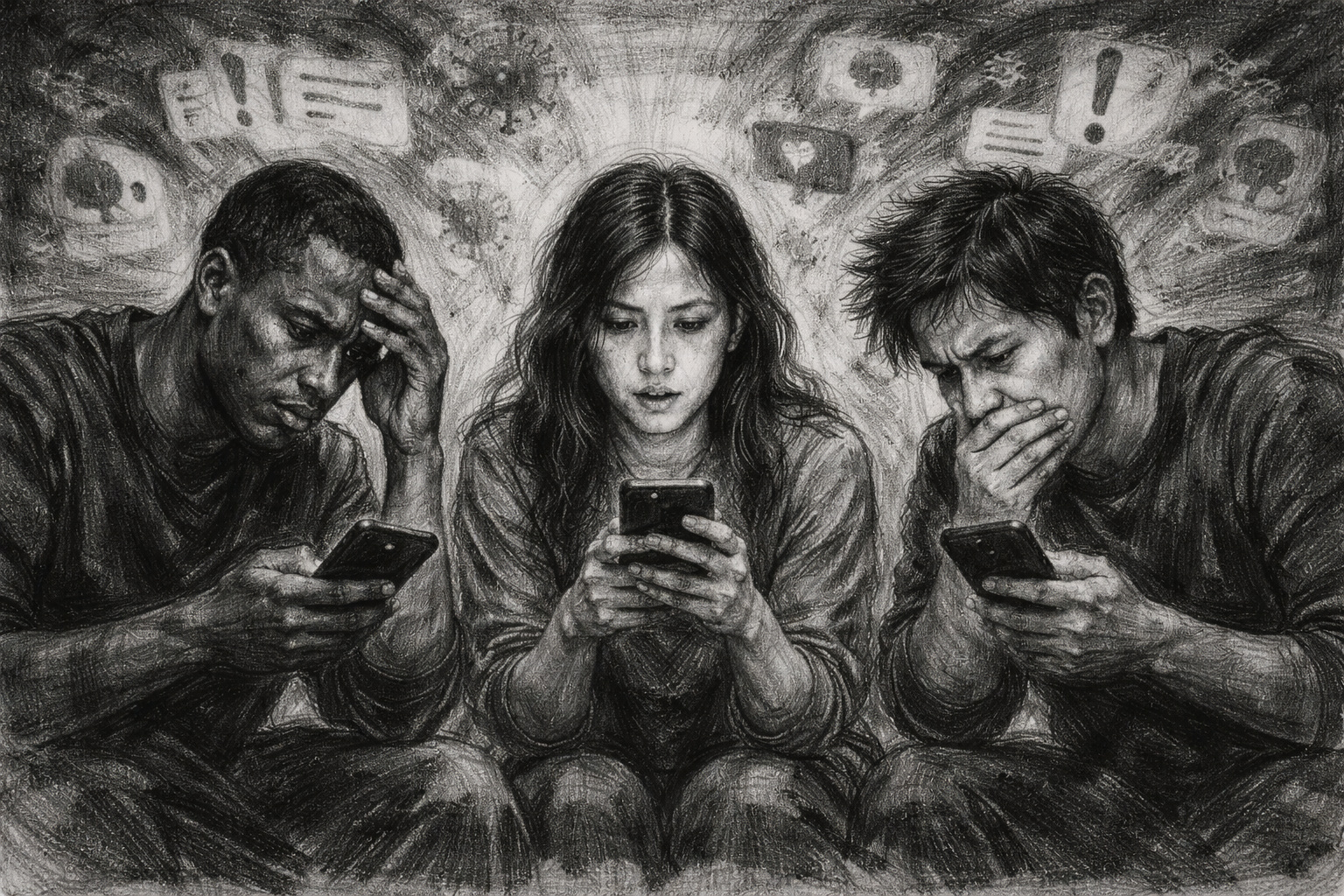
One of the most documented patterns in social media use is doomscrolling, the tendency to keep consuming negative and alarming content long past the point where it serves any useful purpose. People scroll through disaster coverage, crime headlines, and political conflict late into the night, aware that it is making them feel worse, unable to stop. There is a biological reason this happens. The human brain has a negativity bias, an evolutionary feature that causes us to register threats faster and hold onto them longer than positive experiences. That bias kept early humans alive. In the age of social media, it becomes a liability.
Platform algorithms have learned to exploit the negativity bias because content that triggers strong emotional reactions, particularly fear and outrage, generates more engagement than neutral content. People share alarming stories more than reassuring ones. They comment on upsetting posts more than uplifting ones. The algorithm reads those patterns and surfaces more of the same. The result is a feed that can make the world feel far more chaotic and dangerous than it actually is. After enough exposure, anxiety grows not because something is wrong with you, but because the system is working exactly as it was built to work.
The Pressure to Perform Never Clocks Out
There is another layer of stress that gets less attention but affects a wide range of users. Every post, photo, and update is a small performance in front of an invisible audience. People craft captions, choose angles, and time their posts for maximum response. Likes, comments, and shares have become a measurable form of social approval, and the brain treats them as such. When a post performs well, it feels like validation. When it lands quietly, the silence can feel like rejection, even when the rational mind knows that is not what it means.
Delayed responses to messages trigger similar loops. Small social signals that would barely register in face-to-face interaction take on outsized meaning online, where every action or inaction is visible and interpretable. For teenagers especially, whose brains are still developing the capacity for emotional regulation and whose social lives are intensely peer-focused, this constant performance and measurement dynamic adds a layer of pressure that previous generations simply did not carry. It is not imagined pressure. It is a real feature of a world built around visible metrics of social worth.
Teens Carry This Weight in a Way Adults Often Underestimate
Young people experience these pressures more intensely than most adults because the adolescent brain is still developing, particularly in areas responsible for emotional regulation and identity formation. At the same time, social media has become the primary arena where teen social life plays out. Missing a group chat, being left out of a shared moment, or watching peers gather without you carries real social weight at an age when belonging feels essential to survival. Image-focused platforms amplify that pressure by placing constant emphasis on appearance, popularity, and the visible markers of a life worth envying.
Research consistently links heavy social media use among teenagers to increased rates of anxiety, disrupted sleep, and body image concerns. Teen girls appear particularly vulnerable to platforms built around visual content and filtered images, where the standard of what looks normal gets quietly reset week by week. When a young person spends hours each day comparing their unedited self to images that have been lit, filtered, and curated by people whose job is to look good online, the gap between real life and screen life starts to feel like a personal failure rather than a platform design problem.
Sleep Goes First, Then Everything Else
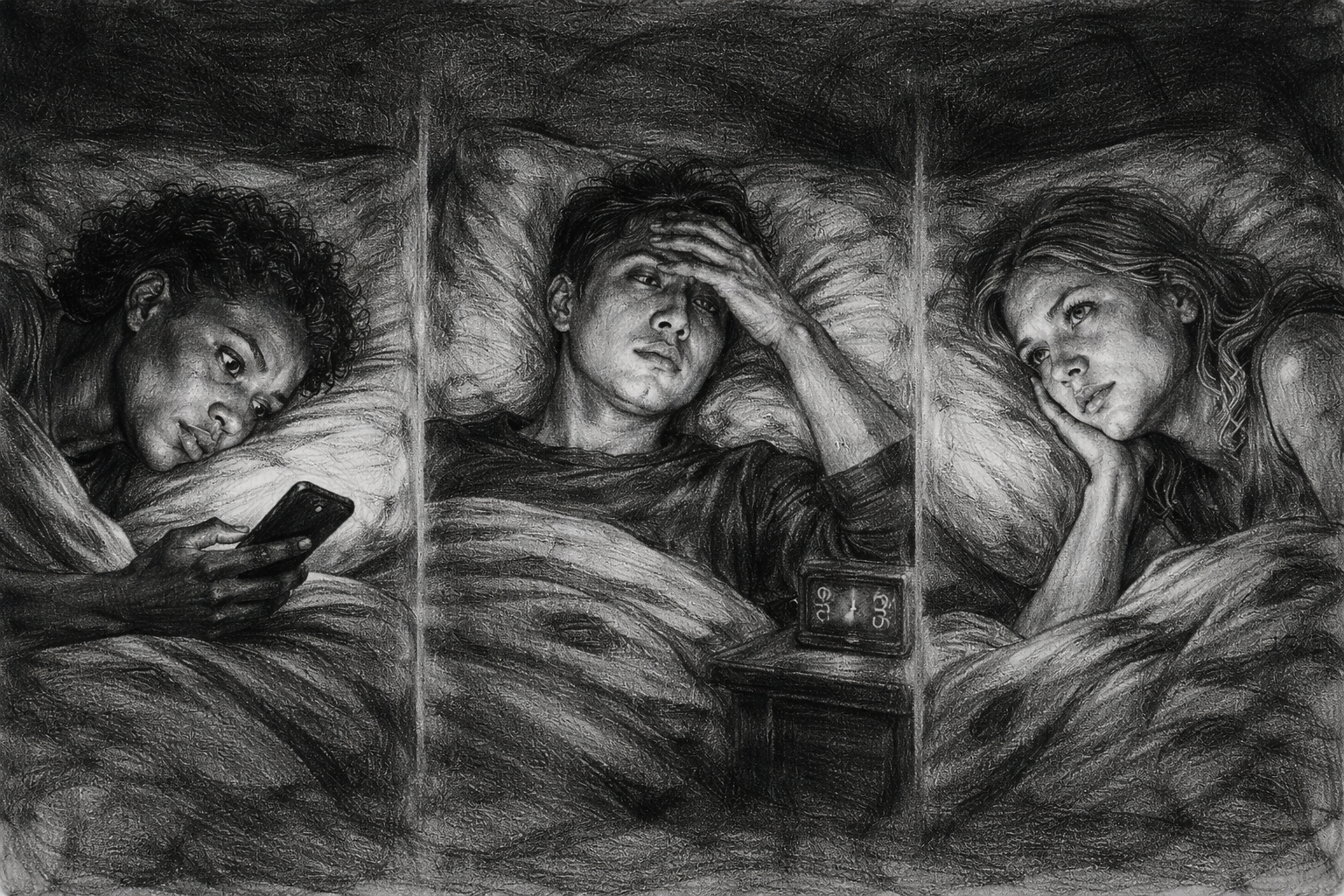
One of the most consistent and measurable effects of heavy social media use is disrupted sleep, and sleep disruption has a compounding effect on anxiety. Most people scroll in bed at night as a way to wind down, which has the opposite effect of what they intend. Screens emit blue light that suppresses melatonin, the hormone that signals to the body that it is time to sleep. At the same time, the content itself keeps the brain stimulated and emotionally activated. A funny video, then upsetting news, then a heated comment thread, then another video. The mind has no chance to slow down.
Platforms are deliberately designed to resist stopping. Autoplay, infinite scroll, and continuous notifications are not accidents of design. They are features built to extend session length because longer sessions generate more advertising revenue. What was intended to be five minutes routinely becomes forty. Chronic sleep deprivation alone significantly elevates anxiety levels, which means that the social media habit disrupting sleep is also feeding the anxiety that makes it harder to fall asleep in the first place. The cycle reinforces itself quietly, night after night.
Connected to Everyone, Lonely Anyway
Perhaps the most counterintuitive outcome of the social media era is that people can feel profoundly lonely despite being constantly, visibly connected. A like is not a conversation. A comment thread is not a friendship. Watching other people interact online does not deliver the same emotional nourishment as spending time together in person, and in some cases it actively highlights what is absent. Seeing friends celebrate together without you, watching peers hit milestones you have not reached, or simply noticing that your feed is full of other people’s lives while yours feels quiet can sharpen the sense of isolation rather than ease it.
Human beings need genuine connection, not just digital proximity. When online engagement begins to substitute for real-world relationships rather than supplement them, loneliness can quietly grow even in people who appear socially active and well-connected by any visible metric. This is one of the more painful ironies of a technology that promised to bring people together. It can, and sometimes does. But it can also create a kind of performance of connection that leaves the real need unmet.
Using Social Media Without Letting It Use You
The goal is not to quit social media entirely. These platforms offer genuine value. They help people stay connected across distance, find communities built around shared interests, access information, and build things worth building. The problem is not the technology itself. The problem is the default mode of use, which is automatic, reactive, and designed to serve the platform’s interests rather than yours. Shifting from automatic to intentional use is simpler than it sounds, and it makes a measurable difference.
Avoiding social media during the first hour after waking and the last hour before sleep protects the two periods when the brain is most sensitive to emotional stimulation. Curating your feed to remove accounts that consistently trigger comparison or leave you feeling worse is an act of self-respect, not weakness. Balancing digital interaction with real-world time spent with people you trust provides what online connection genuinely cannot. None of these changes require willpower or a dramatic lifestyle overhaul. They require deciding that your attention belongs to you, and acting like it does.
Your attention is the most valuable thing you own. Spend it like it matters.
PFWorks, Inc. supports teens and young adults navigating the real pressures of a world that was not designed with their well-being as the priority. Subscribe to our newsletter for honest resources, tools, and stories focused on what actually helps. Share this post with someone who needs permission to put the phone down. The conversation your mental health needs most might be the one that happens in the same room.
R.L. Canty | PFWorks, Inc.