
Part 4: Deepfakes and Intimate Image Abuse
When Technology Is Used as a Weapon
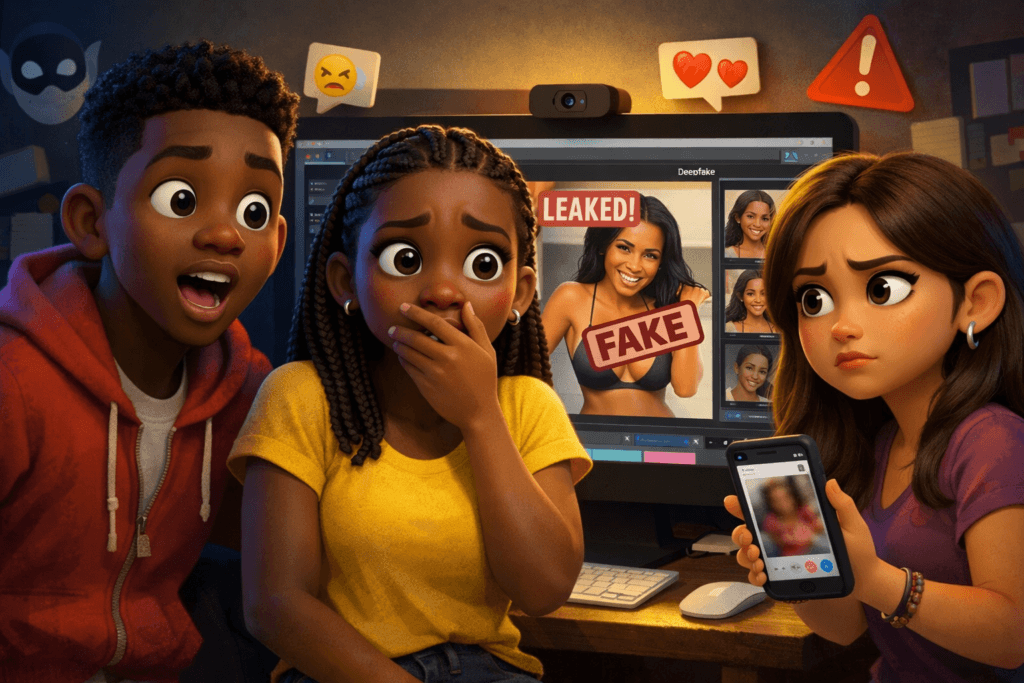
Imagine waking up to a text from a friend that says, ‘Is this you?’ Attached is a video you never made. Your face is in it. The lighting looks right. The expressions look like yours. But you were never there, and you never consented to any of it. That is what a deepfake is, and for a growing number of teens and young adults, that scenario is not hypothetical. It is something they have lived. Deepfake technology uses artificial intelligence to place a real person’s face onto fabricated video or images, often sexual in nature, and the results can be convincing enough to fool classmates, family members, and strangers online.
The cruelest part of a deepfake attack is the powerlessness that follows. Victims are left in the impossible position of proving that a video is fake in a media environment that moves fast and rarely waits for the truth. The lie spreads in hours. The correction, if it comes at all, arrives days later to a much smaller audience. For a teenager still building their sense of self and their reputation, that kind of violation can feel like the ground has been pulled out from under them.
When Trust Gets Turned Into a Threat
Deepfakes are one part of a larger problem called intimate image abuse, and they are not even the most common form. Every day, images and videos shared between people in trust get weaponized after that trust breaks down. A boyfriend or girlfriend asks for a photo meant only for them. It feels intimate. It feels like proof of something real. Then the relationship ends, and what was shared in private becomes a tool for humiliation. The image gets sent to mutual friends, posted in group chats, or uploaded to public sites where it can be found by anyone with a search engine.
For the person targeted, the betrayal goes far deeper than the exposure itself. It is the realization that someone they trusted chose to use their most vulnerable moments as ammunition. Victims frequently describe it as a kind of assault, one that does not leave visible marks but leaves lasting damage to their mental health, their relationships, and their sense of safety in their own skin. The harm is real, it is serious, and it deserves to be treated that way by every adult, school, and platform involved.
Public Shaming That Has No Off Switch
When intimate images go public, the damage does not stay contained. A high school girl in California discovered that classmates had spread a fabricated explicit video of her, generated from nothing more than a yearbook photo. She stopped attending school. The weight of hallway whispers and online ridicule became too much to carry. In another case, a boy’s private photo leaked after a breakup. He became the subject of cruel jokes that followed him online and in person, eventually leading him to transfer schools entirely. These outcomes are not rare accidents. They are patterns, and they are happening in communities across the country.
Public shaming used to be local. It was confined to a school hallway or a neighborhood, and time could soften it. Now it is global, permanent, and searchable. A teen’s worst moment can be indexed and accessible to anyone for years, long after the people involved have moved on. For young people in the middle of building their identity and their future, that kind of permanent spotlight can be devastating in ways that adults who grew up before the internet struggle to fully grasp.
Why Bystanders Make It Worse
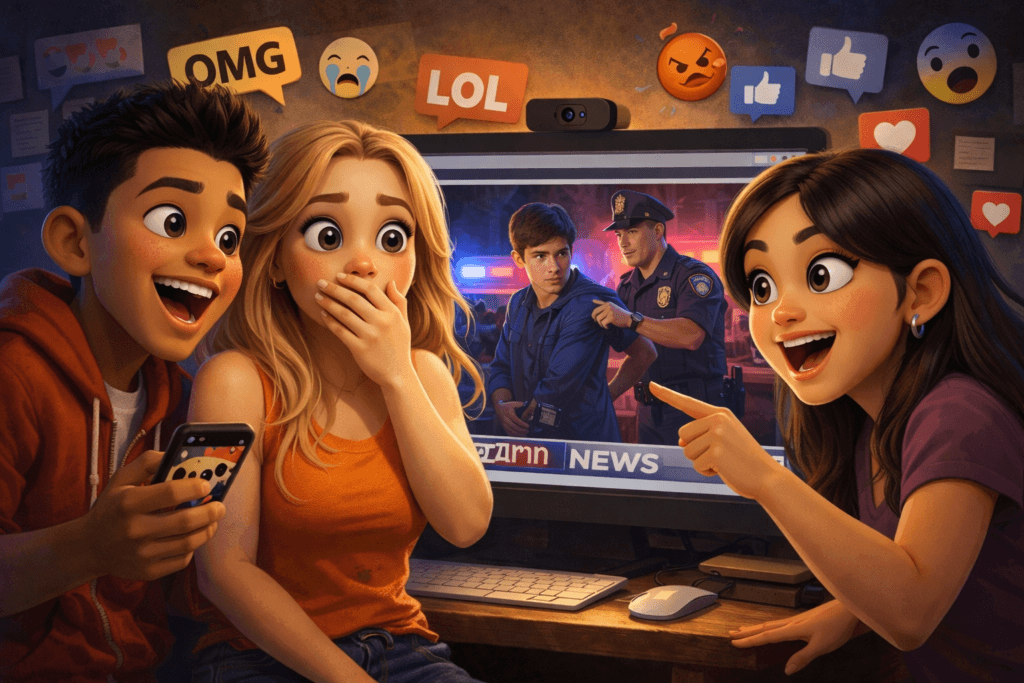
Part of what makes deepfakes and image leaks so destructive is how readily people consume them. The internet has an appetite for scandal, and that appetite does not stop to ask whether the content is real or whether a real person is being harmed by its spread. Classmates who know a video is fake sometimes watch it anyway. People who have never met the person targeted share it for the entertainment value, or simply because sharing feels low-stakes when the damage lands somewhere else. The cruelty is not only in the creation of these images. It is in the casual way bystanders amplify them.
Online culture often lets people off the hook with the phrase ‘it is just the internet,’ as though what happens online is somehow separate from real life. For the person targeted, there is no such separation. The consequences follow them into classrooms, family dinners, job interviews, and every moment they pick up their phone. Choosing not to share, not to comment, not to engage with content that violates someone’s dignity is not a passive act. It is a decision with weight, and it matters more than most people realize.
The Mental Health Cost Is Real and It Lasts
The fallout from intimate image abuse is not measured in views or shares. It is measured in anxiety, depression, panic attacks, and in some cases, outcomes that no family should ever have to face. Teens describe feeling like they have lost ownership of their own bodies, even though nothing physical was done to them. They live in fear of being recognized by strangers. They feel their futures have been hijacked before they even had the chance to build them. Parents and teachers often struggle to respond because the technology moves faster than the laws and faster than most adults’ understanding of how it works.
Victims frequently end up isolated, carrying their experience in silence because the shame feels too heavy to share and because they are not sure anyone would believe them or know what to do. That silence is exactly what abusers count on. It keeps the harm contained in the victim instead of directed at the person who caused it. Anyone who has been targeted by this kind of violation deserves to hear clearly: the shame belongs to the person who did it, not to you. What happened to you is not a reflection of your worth, and it does not define what comes next.
What Fighting Back Actually Looks Like
The path forward is messy and imperfect, but it exists. Laws addressing deepfakes and nonconsensual image sharing are being written and expanded in states across the country, though enforcement still lags behind the technology. Platforms have removal policies for this content, but the process is often too slow and too difficult to navigate for someone already in crisis. Advocacy organizations have emerged specifically to help victims report, remove, and recover, and connecting with one of them can make a real difference in outcomes. No one should have to fight this battle alone or without guidance.
Prevention requires a cultural shift alongside the legal and technical responses. That means educating young people about consent, about the permanence of digital sharing, and about what it actually means to trust someone with something private. It means building communities where violating someone’s dignity online is treated as seriously as violating their safety in person. And it means pressing technology companies to design platforms that protect users rather than treat their images and data as content to be circulated freely. The work is long, but the direction is clear.
If this happened to you, you are not alone and it is not your fault.
PFWorks, Inc. supports teens and young adults navigating some of the hardest situations life can bring. If you or someone you know has been targeted by image abuse or online exploitation, help is available. Subscribe to our newsletter for resources, guidance, and community built around the belief that every young person deserves dignity and a path forward, no matter what they are carrying right now.
R.L. Canty | PFWorks, Inc.