
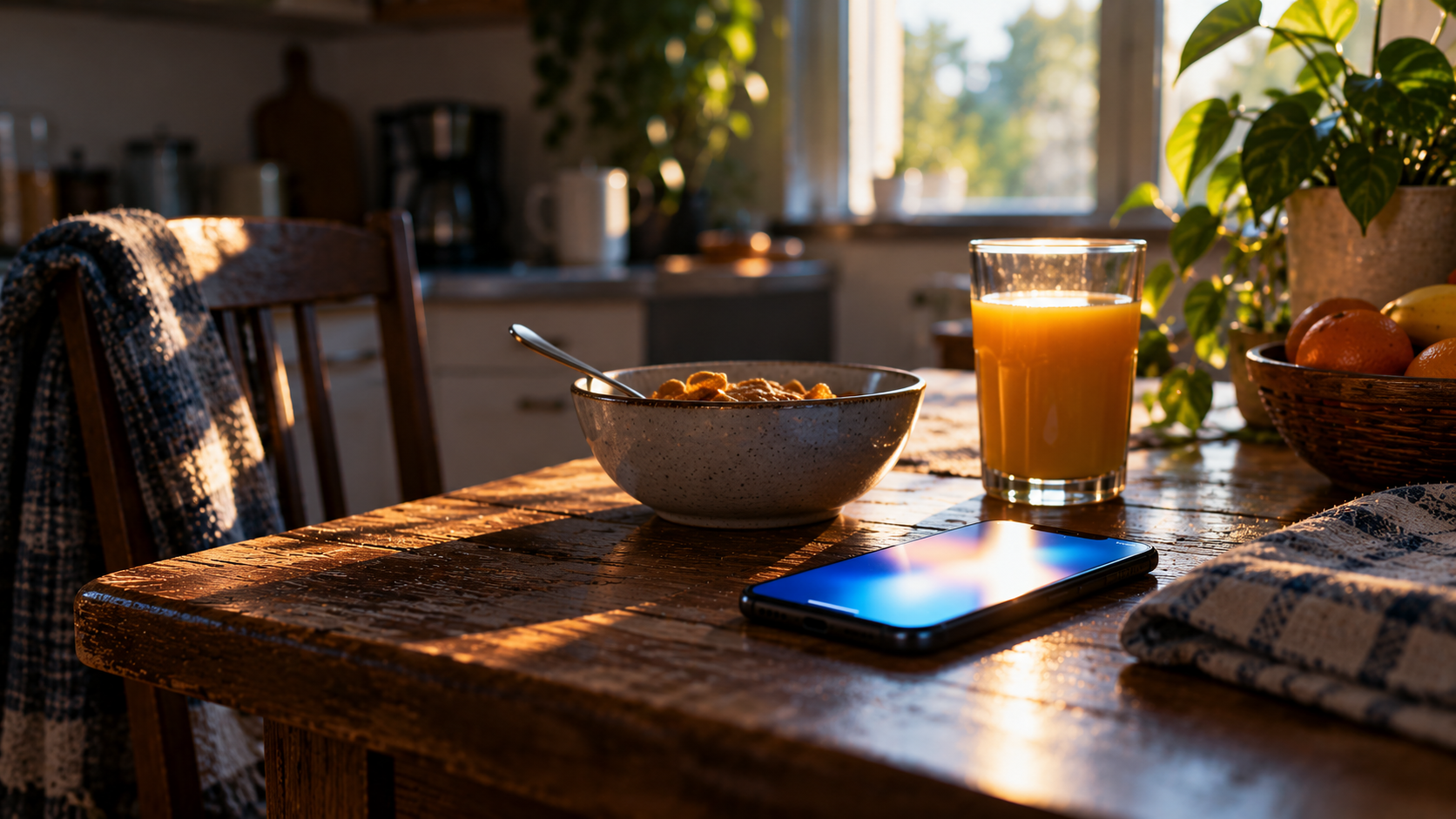
You wake up and the first thing you do is check your phone. Maybe you are not even fully awake yet, but the screen is already on and your thumb is already moving. By the time you put it down, something has shifted. You feel a little worse than when you picked it up, but you could not explain why. Nothing terrible happened. Nobody said anything mean to you. You just feel off. Tense. Like you are behind on something but you are not sure what. That feeling has a source, and it is probably not what you think it is.
A lot of people assume anxiety is tied to something specific. A test coming up. A hard conversation you have been putting off. A situation that has gone sideways. And sometimes that is true. But there is another kind of anxiety that floats just under the surface without a clear cause, the kind that makes you feel restless and unsettled even when your actual life is fine. Researchers are getting clearer on what drives it. And social media is a much bigger piece of that picture than most people realize.
Your Brain Was Not Built for This Volume
Here is something worth understanding about how your brain works. It is constantly scanning for threats. That is not a flaw. It is how humans survived for thousands of years. When your brain detects something that might be dangerous, it sends out a stress signal. Your heart rate picks up a little. Your attention narrows. Your body gets ready to respond. This system works well when threats are real and immediate. It does not work as well when it is running all day on a nonstop stream of upsetting content.
Social media feeds your brain a constant mix of outrage, bad news, conflict, and comparison. Every one of those things can trigger that stress response. And because the feed never ends, the stress response never fully turns off. Your body stays in a low-level state of alert for hours at a time. That is exhausting in a way that is hard to name because it does not feel like tiredness from doing something. It feels more like a weight. Like your nervous system has been running a background program you did not sign up for, and it has been running it all day.
The Comparison Trap Runs Deeper Than You Think
Humans compare themselves to other people. That is also not a flaw. It is how we figure out where we stand and what we want to reach for. The problem is that social media does not give you a real picture of other people’s lives to compare yourself to. It gives you the best moments, the most flattering angles, the wins people decided were worth sharing. Nobody posts the boring Tuesday when nothing worked out. Nobody posts the part where they cried in a parking lot. What you see is a highlight collection that gets presented as a full life.
When you compare your full, messy, complicated real life to someone else’s highlight reel, you will always come up short. And the more time you spend scrolling, the more comparisons you make without even realizing it. You are measuring your body against filtered images. Your social life against someone’s best night of the year. Your progress against a version of someone else that was carefully constructed to look better than the reality. After enough of that, the anxiety does not need a name. It just lives in you like background noise that never quite stops.
Doomscrolling Is Not a Bad Habit. It Is a Stress Response.
People talk about doomscrolling like it is a willpower problem. Like if you just tried a little harder, you would put the phone down. But that misses what is actually happening. When you are anxious, your brain goes looking for information. It wants to know what the threat is so it can figure out what to do about it. Scrolling feels like a way to do that. You are not zoning out. You are, in a way, searching. The problem is that the feed is not actually going to give you the answer your brain is looking for, so you keep going, and the anxiety does not resolve.
That loop is important to understand because blaming yourself for it does not help. Shame does not fix a stress response. Understanding it might. When you notice that you have been scrolling for a long time and you feel worse than when you started, that is information. Your brain tried to manage something by seeking more input, and it did not work. That is not a character flaw. It is a pattern, and patterns can change.
What the Research Actually Says
The research on social media and anxiety has gotten stronger over the last few years. Studies consistently show that heavier social media use is linked to higher rates of anxiety and depression among teens and young adults, particularly for girls. The link is not just about the amount of time spent on apps. It is about what happens during that time. Passive scrolling, meaning you are watching without engaging, tends to produce worse outcomes than active use like commenting or creating. The way you use social media matters as much as how much you use it.
One piece of research worth knowing about: studies that have tracked people before and after taking breaks from social media consistently show reductions in anxiety and improvements in mood. Not huge changes always, but measurable ones. That is not a reason to assume deleting every app will fix everything. Life is more complicated than that, and social media is genuinely useful for a lot of people. But it does suggest that the connection between the feed and the way you feel is real. It is not just in your head. Well, it is in your head. But it is coming from something real.
If You Already Have Anxiety, the Feed Makes It Worse
For young people who are already dealing with anxiety, social media does not create it from scratch. It amplifies what is already there. If you struggle with feeling left out, seeing everyone else’s plans is going to make that worse. If you have a hard time with your body image, a feed full of filtered images is going to make that worse. If the world already feels overwhelming, a nonstop stream of bad news is going to make that worse. The feed is not neutral. It interacts with what you already carry, and that interaction matters.
This is worth naming because a lot of young people who are struggling with anxiety assume the problem is entirely internal. That something is just wrong with them. But if your environment is actively making things harder, that is part of the equation too. You cannot think or meditate your way out of something that has an ongoing external cause. Addressing the feed is not a replacement for other kinds of support. It is part of taking the full picture seriously.
What You Can Actually Do About It
You do not have to delete everything. Most people are not going to do that, and even if they did, it would not solve every problem. What tends to help more is getting intentional about how you use social media rather than just reacting to however it pulls you in. A few things that research and real experience both point to: auditing who you follow and unfollowing accounts that consistently make you feel worse about yourself, setting specific times for checking apps instead of checking them automatically throughout the day, and noticing how you feel after you put the phone down. That last one sounds simple, but most people do not actually do it.
It also helps to build some offline anchors into your day. Things that give your nervous system a break from the constant input. A walk without your phone. Time with someone you actually like. Something you do with your hands. These are not cures, and they are not magic. But they interrupt the loop long enough to give your brain a chance to come down from that low-level alert state it has been running in. Over time, small interruptions to the pattern add up.
When to Take It More Seriously
There is a difference between the ambient anxiety that comes from too much screen time and anxiety that is significantly getting in the way of your life. If you are struggling to sleep, avoiding things you used to care about, feeling a persistent sense of dread that does not lift, or having panic attacks, that is worth talking to someone about. Not because something is deeply wrong with you, but because that level of anxiety is treatable and you do not have to white-knuckle through it alone. A therapist or counselor can help. So can a doctor. So can a trusted adult in your life who will take you seriously.
If you are not sure where to start or you do not have easy access to those resources, PFWorks can help you find what is available in your area. There are free and low-cost mental health options that exist specifically for young people, and navigating them is easier with someone who knows where to look. You do not have to figure that out by yourself.
The anxiety you cannot name deserves to be taken seriously. And the first step is understanding where it might be coming from.
If you are looking for mental health resources, support navigating what is available in your area, or just want to understand more about what you are dealing with, reach out to PFWorks. We exist to help you find what you need, no judgment, no runaround.
R.L. Canty | PFWorks, Inc.