
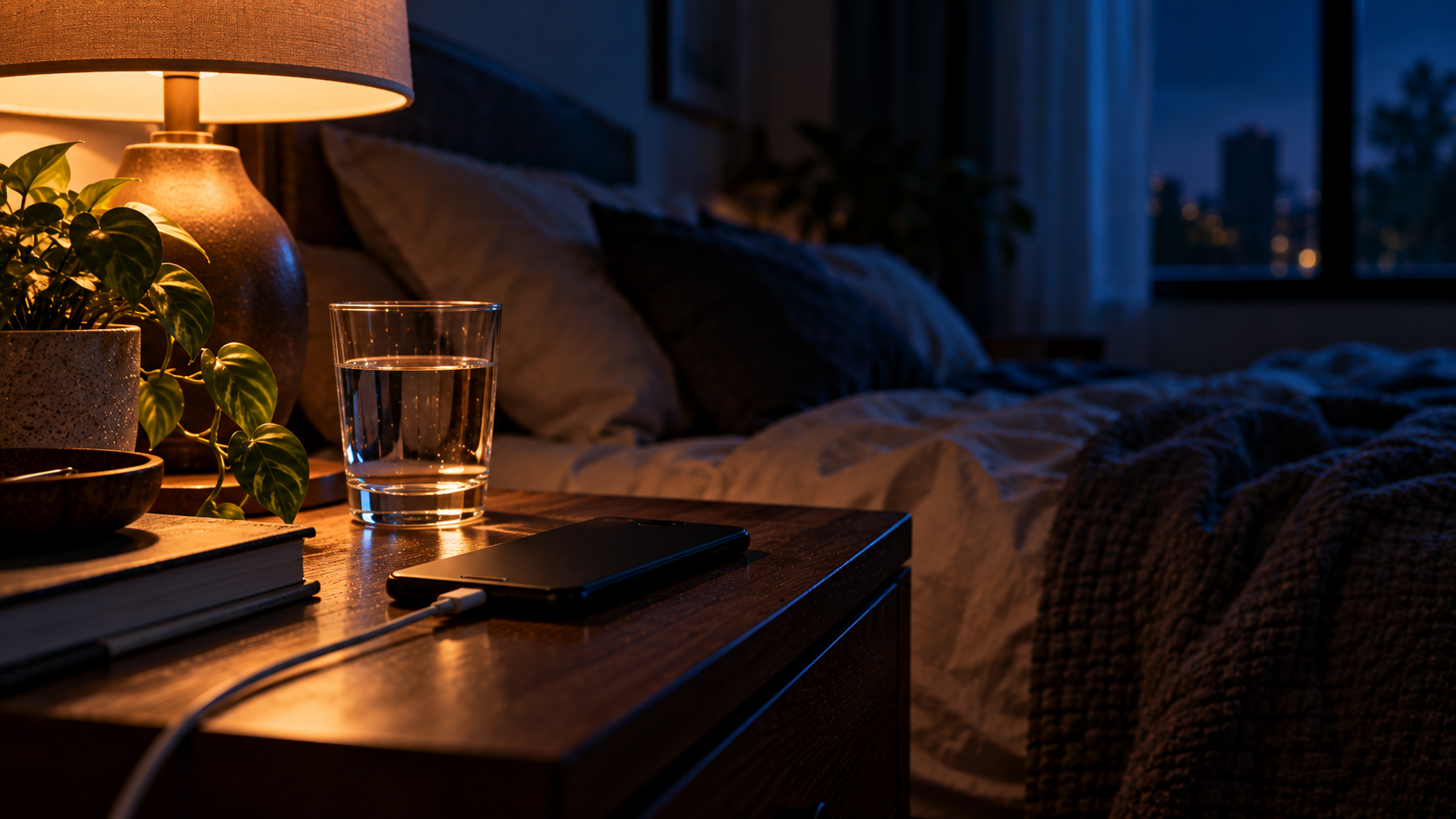
Nobody tells you that sleep is a mental health issue. They talk about it like it is a hygiene habit, something you fix with a new pillow or a chamomile tea routine. But for a lot of young people between 16 and 24, the reason sleep is broken has nothing to do with comfort and everything to do with what is happening inside their heads at night. Anxiety does not clock out. Hypervigilance does not take a break just because the lights went off. And the phone sitting next to the bed is not the root cause of any of that. It is just the thing that makes it worse.
Here is what actually happens. When your nervous system has been running in overdrive, either because of a chaotic home environment, housing instability, trauma, or just the constant weight of not knowing how things are going to turn out, it does not automatically downshift at night. Your brain is still scanning. Still watching for threats. Still processing everything it could not afford to process during the day. Reaching for your phone in that moment is not laziness or a bad habit. It is your brain trying to do something with all that energy. Understanding that does not fix the problem, but it changes the conversation entirely.
Why Sleep Gets Complicated When Life Is Already Hard
Sleep science talks a lot about blue light and dopamine loops, and those things are real. The light from your phone screen suppresses melatonin, which is the hormone your body uses to wind down. Scrolling keeps your brain in an alert, reactive state when it is supposed to be shifting into something quieter. That part is biology, and it applies to everyone. But the research on sleep is mostly built around people who have stable places to sleep, consistent schedules, and lives that do not require constant vigilance. That is not the reality for a lot of young people, and pretending it is does not help anyone.
When you are sleeping somewhere that does not feel fully safe, your nervous system does not get the signal that it is okay to let go. When you are worried about where you will be next week, or replaying a conversation that went badly, or trying to figure out how to handle something tomorrow that you do not have the resources to handle, your brain has real work to do. The phone becomes the way you manage that. It gives you something to focus on that is not the worry. It gives you company when you feel alone. It gives you stimulation when your brain is too activated to settle. Telling someone in that situation to just put the phone down is not wrong, but it is incomplete.
What Chronic Sleep Loss Actually Does
Most people know that not sleeping enough makes you tired. That is the obvious part. What gets less attention is how quickly poor sleep starts affecting everything else. After a few nights of getting less than six hours, your ability to regulate your emotions drops significantly. Things that would normally feel manageable start feeling like emergencies. Your impulse control weakens. Your memory gets worse. The part of your brain responsible for decision-making, the prefrontal cortex, literally functions less effectively when you are sleep-deprived. This matters a lot for young people who are already navigating situations that require good judgment and emotional steadiness.
There is also a direct connection between sleep deprivation and mental health that does not get talked about enough in circles that serve young people. Chronic sleep loss increases the risk of depression and anxiety. It makes existing mental health conditions harder to manage. It lowers your resistance to substance use as a coping mechanism because your brain is desperately looking for relief. None of this means that poor sleep causes every problem, but it is a serious amplifier. When systems fail young people, one of the first things to go is sleep. And then everything else gets harder.
The Difference Between Sleep Hygiene and Sleep Reality
Sleep hygiene is the term used to describe the habits that support good sleep. Keep a consistent schedule. Avoid caffeine in the afternoon. Make your room cool and dark. Put the phone away an hour before bed. These are all reasonable suggestions for someone whose biggest obstacle is discipline. They are significantly less useful for someone who is couch surfing and sleeping in a different place every few nights, or who works a closing shift at a fast food job and does not get home until midnight, or whose younger siblings need attention after school and the only quiet time they get is after 1 a.m. Sleep hygiene advice that ignores context is not bad advice. It is just advice for a different life.
What actually helps in harder circumstances is smaller and more realistic. If you cannot control your schedule, you can control the twenty minutes before you close your eyes. Putting on something low-stimulation, a familiar show, ambient sound, a podcast you have already heard, gives your brain something to track without activating it. Keeping the phone across the room instead of in your hand changes the physical behavior even if it does not change the urge. Writing down whatever is looping in your head before you try to sleep, even just a list, gives your brain permission to let go because you have not lost the thought. These are not magic fixes. They are small shifts that create slightly better conditions.
Screens Are Not the Enemy. Exhaustion Is.
The conversation around screens and sleep gets moralistic really fast, and that does not serve anyone. Phones and social media are not inherently destructive. For a lot of young people, especially those who are isolated or in unstable situations, their phone is their primary connection to people who care about them, information they need, and communities where they feel like they belong. Telling someone to cut off their lifeline because it is bad for their sleep schedule misses something important. The goal is not to eliminate the phone. The goal is to build enough of a wind-down buffer that your body has a fighting chance at rest.
There is also something worth naming about how exhaustion gets normalized for young people who are already carrying a lot. Tired becomes your baseline. You stop expecting to wake up feeling rested because that has not been your experience for so long that you have forgotten it is even possible. Part of what PFWorks tries to do is name the things that get normalized in hard circumstances and say clearly that they should not be. You deserve sleep. Not as a wellness goal. Not as a productivity hack. As a basic human need that the systems and circumstances around you have made harder to meet, and that matters.
What You Can Actually Do Tonight
None of this requires a perfect situation. If you are in a stable place tonight, that is a good night to try something. Give yourself fifteen minutes of lower stimulation before you try to sleep. Not an hour. Not a whole new routine. Just fifteen minutes. Put the phone across the room if you can. If you cannot, turn the brightness all the way down. Put on something you have already seen or heard so your brain is not working to track something new. If your mind is running, write three sentences about what it is running about and then close the notebook. These are small things. Small things still count.
If sleep has been broken for a long time, especially if it is connected to trauma, anxiety, or a living situation that has not felt safe, that is worth talking to someone about. Not because something is wrong with you. Because you deserve actual support, not just tips. PFWorks is a resource navigator. We do not have every answer, but we can help you find people who do. That is what we are here for.
Tired is not who you are. It is what happens when the world does not give you enough room to rest.
PFWorks exists to help young people between 16 and 24 find real support for real problems. If sleep, stress, or anything else is making life harder to carry, reach out. We are here to help you navigate what comes next.
R.L. Canty | PFWorks, Inc.